 Subscribe in a reader
Wednesday, 27 May 2009
030509 Ah Khai Famous Char Siew, Seaview, Malaysia
If you’re making a signboard with your stall’s name on it, why not add the word ‘famous’ in there?
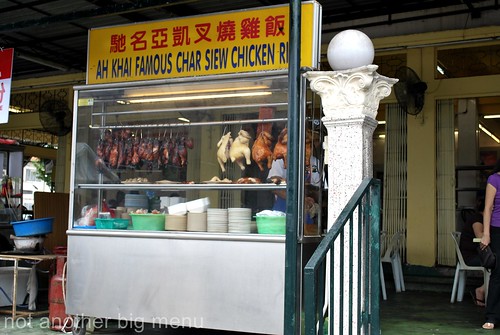
A concept I totally agree with, especially as the food is so very definitely unmistakably good.
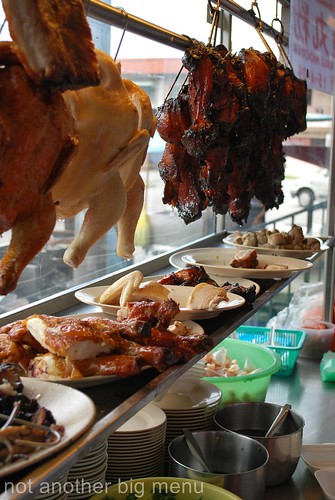
Before this place came along, we used to like the char siew (BBQ roast pork) at Tengkat Tong Shin in KL. Whether or not this char siew actually was at said place is another debate altogether, because in Malaysia, people tend to refer to a restaurant or stall by it’s commonly known name, which may or may not be its actual name.
Thing is, if you’re from Malaysia, you already know which char siew place I’m referring to.
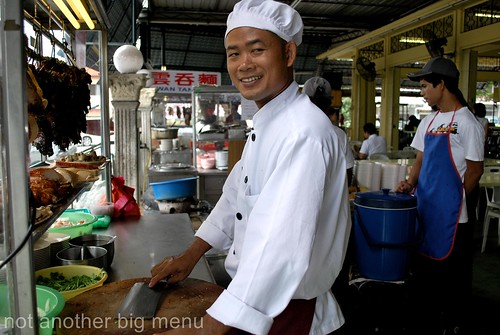
When my parents then took me to this char siew place, we immediately knew we’d found a more than adequate substitute for the KL version. It also helps that the guy manning the place likes being photographed, and has such a cherry smile.
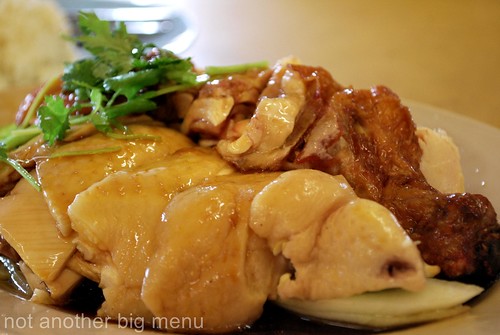
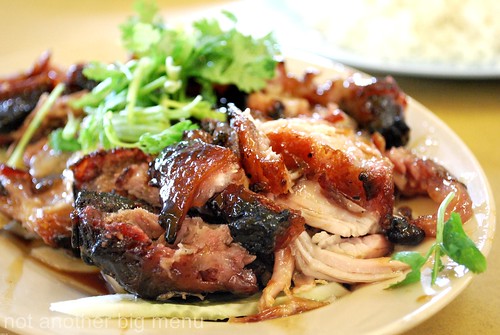
Roast chicken and steamed chicken with cucumber and sauce
If the East and the West could do chicken-part-exchange, everyone would benefit. While Western cuisine tends to favour chicken breasts in almost every type of dish, this is one part of the chicken that does not sell too well in Malaysia. The reason for this is because it’s seen as tougher, drier meat which is less tasty compared to the other bits of the chicken, namely the thigh and the ribs.
Thus, in almost every dish, people will take the effort to tell the chef not to include any chicken breast in their dish.
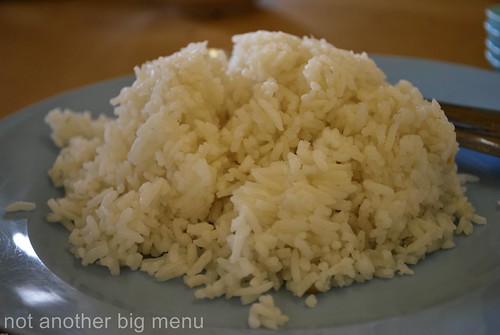
The plate of chicken seen here had smooth, tender, tasty chicken which was eaten with rice cooked in chicken stock.
Char siew superstar (BBQ pork extravaganza)
There are no words to describe this dish. OK, there are a FEW words to describe this dish, but those words can only be:
Magnificent
Incredible
Unbelievably delicious
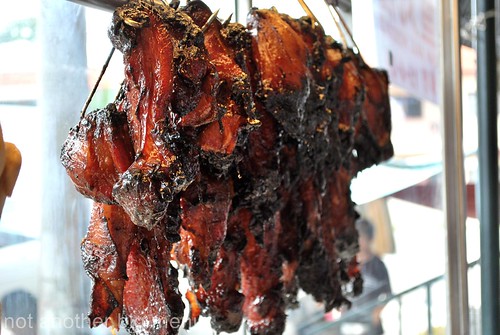
The pieces of pork are so tender, so meltingly smooth and soft, and so tasty with sticky caramelised sweet and tangy sauce. Each bite starts with a satisfyingly sweet crunch, followed by a soft and chewy meaty centre, ending with a mouthful of flavoured rice to cleanse the palate.
You have to try this to believe it.
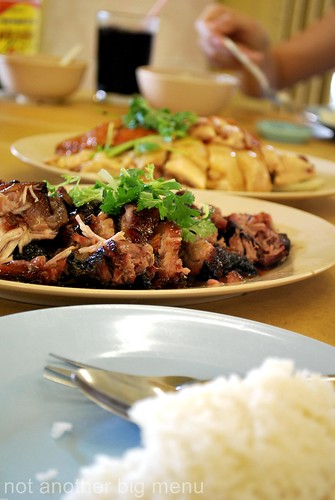
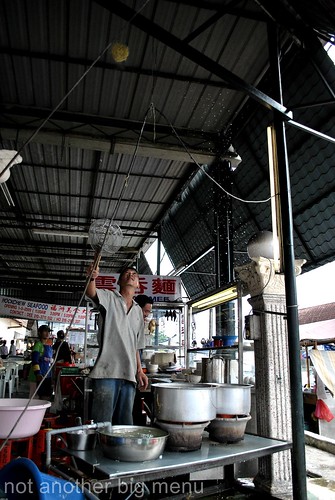
The Super Noodle-Tossing Man
While waiting for our food to arrive, we were distracted by the guy at the wantan noodle stand who, every few minutes, tossed noodles into the air. Usually, a man tossing noodles into the air won’t get much attention, but when you’re tossing noodles 5 metres into the air, and catching it successfully with a metal sieve, that deserves some oohs and aahs.
When my dad and I asked if we could take his picture, he nodded but didn’t say much. His friends then started shouting ‘Woooo, you’re being photographed!!!’, and the show-man in him emerged. Tossing the noodles not once, not twice, but FIVE times in the air and successfully catching it (oh I was so worried for the noodles), it was an impressive display.
I’d recommend this char siew to anyone, so I would most definitely like to come back to this place.
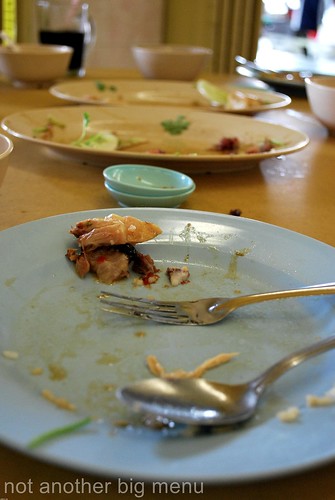
This is how much we like it.

030509 Tao Foo Fah, SS2 outside Savemart
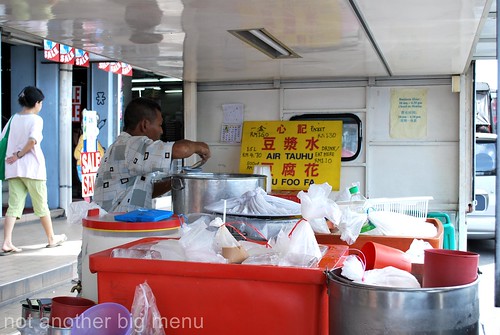
Our friend the tao foo fah man whom we’ve been buying from since the early-80’s. Although not based at any permanent spot, everyone knows not to park at the spot he parks at so it’s pretty much permanent anyway. He’s there from Tuesdays to Sundays, from about 10am to evening time.
Considered one of the masters of this delicate dessert, he’s one of the first to start a stall selling this which is why he remains popular till today. Unlike some other tao foo fahs which are watery and without substance, this one manages to be silky smooth, yet contain enough substance and taste in each spoonful.
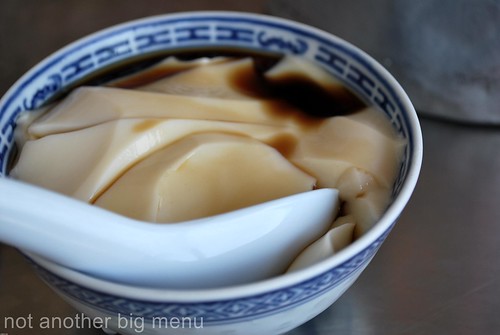
It’s RM1.10 per bowl, and when he asked me how much one of these sold in England and found out that it was about £2.50 - £3, it really looked as though he might be considering another business over there.
Haven’t posted for over a week as I’ve been enjoying the local delights, and this was one of them so I most definitely recommend this.
Tuesday, 5 May 2009
030509 Section 14 Chee Cheong Fun, Hai Keng Restaurant, 24, Jalan 14/20
My grandfather and I share one eating habit, that is, when we find something we like, we eat that thing pretty much consistently over a period of time. This chee cheong fun stall has been a favourite of ours for a while.
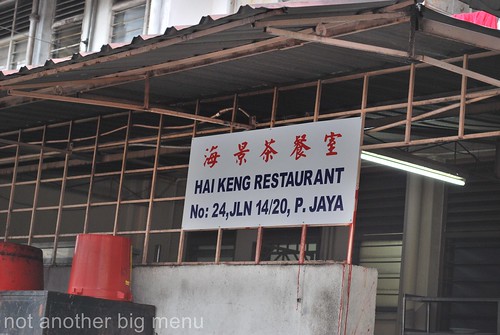
The owner of the stall is a guy of few words, which is reasonable considering how many sheets of chee cheong fun he has to chop (lots and lots).
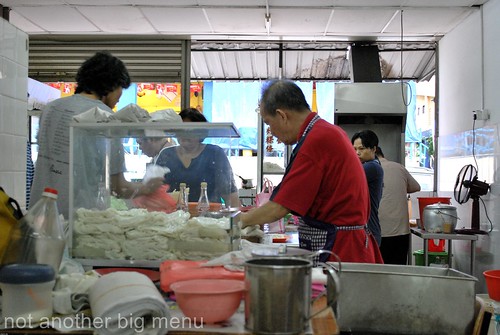
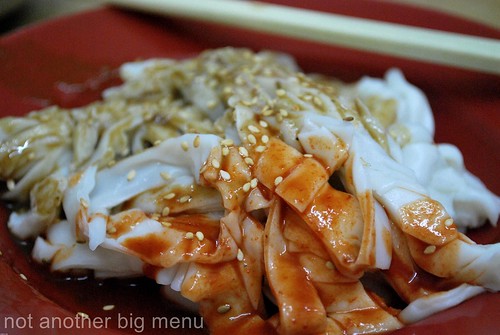
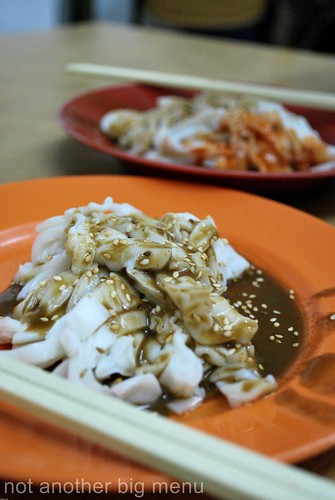
Chee cheong fun is a type of rice noodle, which is made by pouring a mixture of rice flour, water, and some other ingredients onto a hot cloth on a hot metal plate. This thin sheet is then steamed for a quick while, lifted off the sheet and quickly folded. When it is to be served, it’s chopped into thin slices and a ‘teem cheong’ (sweet sauce) made of black beans (among other ingredients) is poured over it. It’s also sometimes eaten with green chillies and chilli sauce, but I prefer mine with the teem cheong alone.
According to my grandfather, who’s read the newspaper article in which the chee cheong fun man was featured, and who’s had many conversations with the guy while waiting for his order, this chee cheong fun man starts his day at about 3am daily.
He makes the noodles himself, and that alone takes a few hours as he makes 4 to 5 boxes of these things. He then opens shop at about 7am when the breakfast crowd arrive, and keeps going till about before noon when the noodles run out.
Typically eaten as a light breakfast, it’s almost comfort food to us. Would I recommend this? Most definitely so.
020509 Ming Tien Food Centre, Taman Megah, Malaysia
Somewhere near the centre of the Universe that is SS2 (in Malaysia, and if you’re not from there, you just won’t understand how much of a centre of the Universe this place is), there is a food court called Ming Tien. The literal translation is ‘Tomorrow’. Perhaps they were going for the ‘return customer’ angle when naming the business.
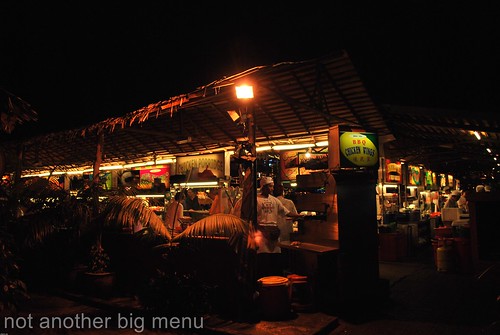
The ambience (perhaps a slightly pretentious word) here is that of a beach party, but with lots of food. Lots of tables, plastic chairs and a wireless button system where one press of the blue button results in a waiter coming to the table.
If only we had this at McDonald’s.
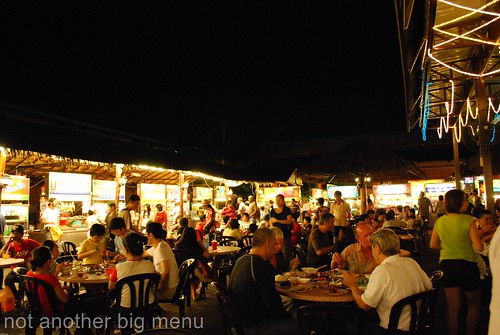
At this beach party, there are lots and lots of food stalls, each one selling a different thing. Mainly focusing on food of the Chinese variety, you can find almost every type of dish here. With your table number, you order the dish (i.e. Number of, spicy or not, what type of noodle) and the dish gets brought to your table.
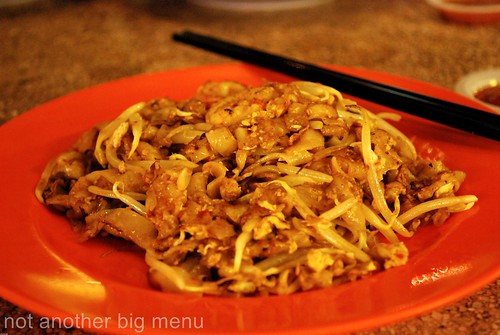
Char Kuay Teow RM4
Known as the King of Noodles in Malaysia (lots of things are Kings of something so I wouldn’t take this too literally), this is a dish that everyone should try at least one (hundred) time(s). Made with ‘hor fun’ which is a flat rice noodle, and fried with eggs, prawns and beansprouts (added when it’s nearly ready to retain texture), this is a very popular dish among the locals, so much so that you just have to say CKT and people will know what you mean.
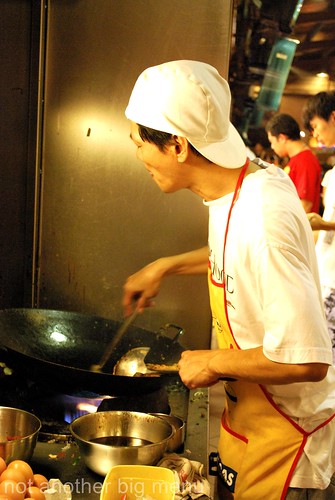
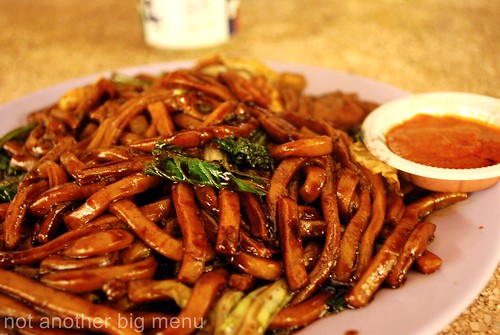
Hokkien Char (Thick noodle) RM5
‘Hokkien’ is another way of saying Fu Jian which is a place in China, and as this dish was originally made by the people who came to Malaysia from Fu Jian, this is known as Hokkien Char (‘char’ being ‘fried’). The default noodle used is the thick noodle, also known as the fat noodle which seems to be found only in Malaysia (and even then, only in certain states).
The colour of the dish comes from the thick, dark soy sauce which is a caramel-tasting, black sauce used to flavour as well as to colour certain foods. This noodle was one of the better ones I’d tasted, and for RM5 (GBP1 = RM5.30), we enjoyed it lots.
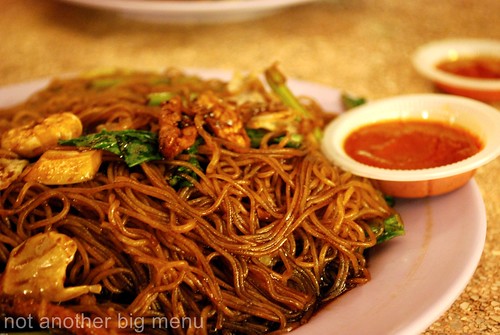
Hokkien Char (meehoon, or rice vermicelli) RM5
Same dish, but using a different type of noodle. You’ll be surprised at what a difference the type of noodle makes, as this is the main thing that decides how much sauce is absorbed by the noodle, thus how tasty it is. This dish had the potential to be really good, especially if it was just dry enough, and just charred enough with the taste of coal used in cooking it. This version wasn’t as good, as it lacked ‘wok hei’, which is translated literally as ‘heat of the wok’, and tasted more like it was stirred in sauce, rather than fried on hot heat in sauce.
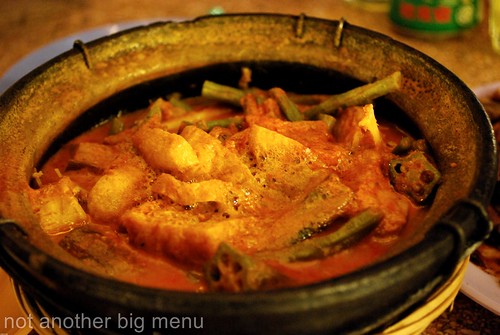
Claypot curry fish head RM10 per pot
The name alone might need alot of explanation if you’ve never had this before. Claypots are pots made from clay which are used for cooking, as well as serving, because the cooking process takes a while to heat the pot up, after which it retains the heat for a long period of time. Much longer than other means of food serving, such as the glass plate.
Fish head is eaten (and very much liked) by Malaysians, and most of the people in South East Asia. Commonly seen as being cat’s food, or even worse by people living in the West, us South East Asian people love the delicate textures and tastes which can be found in the head of the fish. Obviously, to find anything in the head of the fish, the fish is going to have to be a big one.
This is a sour-ish curry, made with coconut milk, and tamarind (at a guess) to achieve the sour taste. Lots of vegetables and tofu puffs make up the rest of the dish.
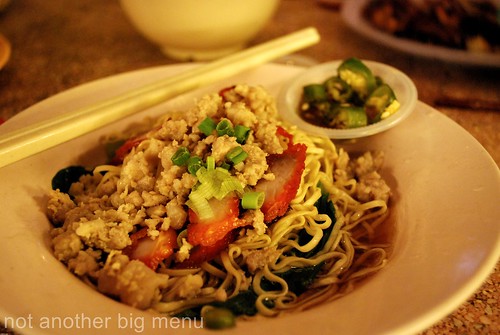
Sarawak Kolo Mee RM4.50
It’s supposed to be pronounced ‘kon low mee’ which translates to dry-mixed noodle but somewhere along the line, the spelling and pronunciation seems to have taken a step back. Handmade noodles are ‘mixed’ or tossed in a sauce, and garnished with minced pork meat. Nothing remarkable here.
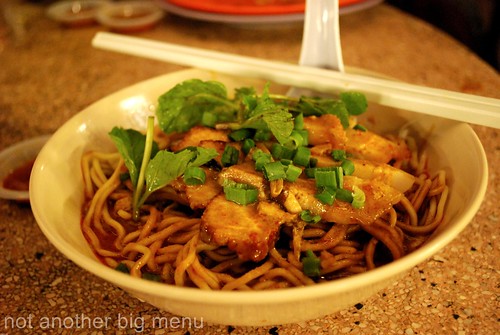
Ipoh Dry Curry Noodle RM4.50
This is yellow noodles, mixed with curry sauce, and one of our favourites here, but this time it wasn’t done that well so we didn’t finish it.
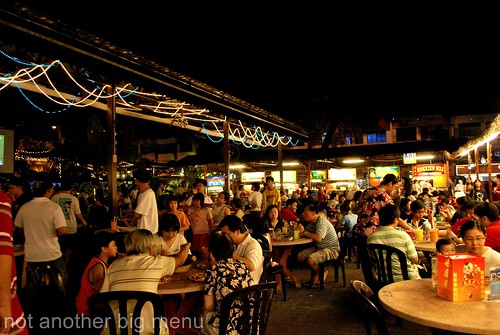
Although not every stall here serves the best versions of their dish, this is a popular place with the locals. Lots of space, lots of food, and a huge plasma TV showing the latest English football matches (real time) make it one of ours also.
Malaysian Airline food – in anticipation of better food
Why did I choose to have airplane food featured on this blog? Some might say it’s because I have no standards when it comes to food, and that may be true, but the reason for this was so that the rest of the food would look so much better.
Featuring airplane food from Malaysian Airlines.
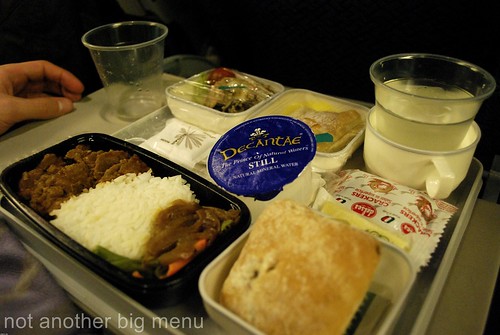
This was the beef rendang, described as chilli beef which may have been misleading to anyone familiar with the more Mexican version of chilli beef. The current economic condition seems to have resulted in clingfilm being used instead of the transparent plastic covers that were used before, so it looks very much more … home-made.
The rice was very coconut-y, which is good because it’s supposed to be like that. The beef was much more flavourful than the chicken I had, so in a way, that was good also as I didn’t want to fill myself up with airplane food.
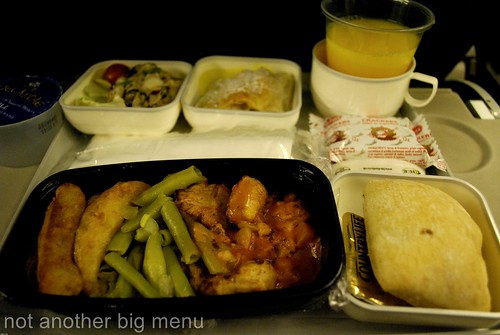
Roast chicken with potatoes, with green beans which had been cooked from the day before, and only taken out the day after (it tasted like that anyway).
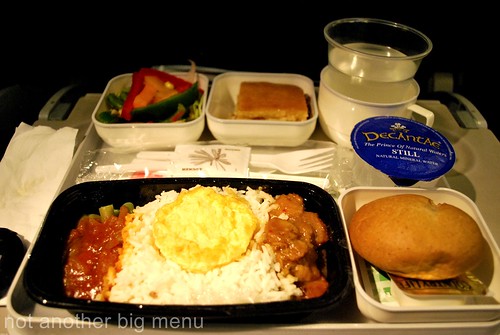
Overall, for plane food, I’d say it was OK, and definitely made us look forward to the meals that were coming up next, in Malaysia if you haven’t guessed already.


